Why Inconsistency Creates Emotional Addiction
There is something uniquely painful about loving someone who is sometimes everything you need and sometimes nowhere to be found.
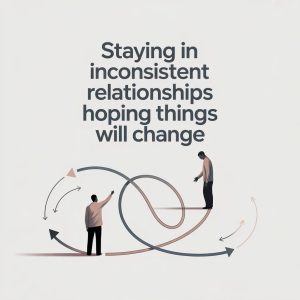
Inconsistent relationships rarely begin with obvious red flags. They begin with moments of intensity. Connection feels deep. Conversations feel meaningful. Affection feels real. You experience closeness that gives you hope. And then, without warning, the energy shifts. Communication slows. Effort decreases. Warmth turns into distance.
The unpredictability is what keeps you attached.
Inconsistency creates emotional addiction because it mirrors a psychological pattern known as intermittent reinforcement. When affection and attention are given unpredictably, your brain works harder to secure it. You become hyper-focused on the next “good” moment. The highs feel powerful because they follow lows. Relief feels like love.
You are not addicted to the person. You are attached to the cycle.
When someone is consistent, your nervous system can relax. When someone is inconsistent, your nervous system stays alert. You analyse texts. You replay conversations. You try to decode tone. You search for reassurance in small gestures. You start believing that if you just say the right thing or behave the right way, stability will return.
Hope becomes the hook.
You stay not because you are naïve, but because you have seen potential. You remember the version of them that was attentive, affectionate, emotionally present. You convince yourself that version is the “real” one, and the distant version is temporary. So you endure. You wait. You adjust.
But inconsistency is not confusion. It is information.
Emotionally inconsistent love destabilises your sense of security. It keeps you oscillating between closeness and anxiety. The unpredictability intensifies your attachment because your body begins craving the relief that comes when attention returns. This is why inconsistent love can feel more addictive than stable love. The relief feels euphoric.
Yet what feels euphoric is often just the temporary absence of stress.
Healthy love does not rely on withdrawal to feel powerful. It does not require emotional drought to make affection meaningful. It is steady. Reliable. Clear. It does not leave you questioning your place.
When you stay in inconsistency hoping things will change, you slowly compromise your emotional peace. You silence your needs. You rationalise red flags. You normalise anxiety. You tell yourself patience is maturity. But patience does not require self-abandonment.
Consistency is not too much to ask for. It is the baseline of emotional safety.
Breaking free from emotional addiction requires recognising that unpredictability is not passion. Anxiety is not chemistry. And intensity is not intimacy. True intimacy is built through reliability. Through repeated presence. Through actions that align with words.
You deserve a love that does not disappear when it is inconvenient. You deserve communication that does not fluctuate with mood. You deserve steadiness.
If someone can only offer you fragments, it is not your responsibility to assemble them into something whole.
Love should feel grounding, not destabilising.
And the moment you stop romanticising inconsistency is the moment you begin choosing peace.