You have been showing up fully for someone who gives you pieces of themselves. This post is for the woman who already feels it but has not yet found the words.
There is a particular kind of exhaustion that comes with a one-sided relationship. It is not loud. It does not announce itself with drama or obvious cruelty. It settles in quietly in the weight of always being the one who reaches out first, always being the one who apologises, always being the one holding the relationship together while wondering why it still feels like it is falling apart.
You love this person. That is not in question. But love, by itself, is not a relationship. A relationship requires two people who are both present, both investing, and both choosing each other consistently, not occasionally, not only when it is convenient.
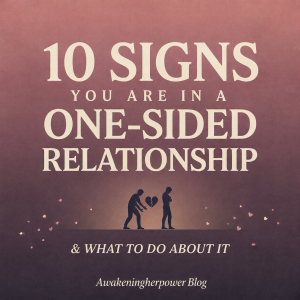
If you have been wondering whether what you have is a relationship or a one-woman performance of one, read these ten signs carefully. And then read what to do about them because awareness without action only deepens the wound.
01 You are always the one who initiates
Think back over the last two weeks. Who sent the first message? Who suggested the plans? Who reached out after the argument to restore connection? If the answer is consistently you not occasionally, but almost always that is not a coincidence. That is a pattern. And patterns are data.
In a healthy relationship, both people want to connect. Both people feel that pull toward the other. When only one person is doing the reaching, the other person is simply receiving and they have grown comfortable doing so because you have made it possible for them to.
Initiating sometimes is love. Initiating always is a warning sign that deserves to be taken seriously, not explained away.
02 Your needs are consistently treated as secondary
There is a difference between a partner who occasionally cannot show up for your needs because life is real and people have limits and a partner who has established a pattern of placing their own comfort, desires, and priorities above yours as a default operating mode.
When your needs do come up, what happens? Are they received with genuine interest and care? Or are they minimised, redirected, or met with a response that somehow ends with their needs at the centre of the conversation? A one-sided relationship does not only take from you financially or physically. It takes from you emotionally slowly, consistently, until your own needs start to feel like an imposition rather than a natural part of being human.
You are not asking too much by having needs. You are asking a person who is not yet ready to give what love requires.
03 You carry all the emotional labour
Emotional labour is the invisible work of maintaining a relationship remembering important dates, tracking the emotional temperature of the dynamic, knowing when to bring something up and when to let it go, managing conflict, creating connection, holding space. In a healthy relationship, this work is shared. Not perfectly split, but mutually carried.
In a one-sided relationship, you are the relationship manager. You are the one who notices when things are off. Who initiates difficult conversations. Who thinks carefully about how to raise an issue without causing a blowup. Who apologises to restore peace even when you are not the one who caused the rupture.
This labour is invisible and exhausting. And the fact that he does not notice you doing it is, itself, part of the problem.
04 You make excuses for their behaviour constantly
He did not call because he was busy. He cancelled because he had a hard week. He went quiet because he is going through something. He forgot because he has a lot on his mind. Every one of these things may occasionally be true. But if you are running a continuous internal operation whose sole purpose is explaining away his behaviour to yourself and to the people who love you, pay attention to what that operation is costing you.
The woman who is constantly defending a partner’s inconsistency to her friends, to her family, and most painfully to herself, is a woman who has taken on the job of protecting the image of a man who is not protecting her heart. You should not have to work this hard to justify someone’s presence in your life.
05 You feel more anxious than at peace
This one is about what the relationship does to your nervous system. Not in the dramatic moments anyone feels anxious in those. But in the ordinary, quiet, in-between moments. When you have not heard from him in a few hours. When a message comes through and you feel a spike of anxiety before you read it. When you spend time with him and find yourself monitoring his mood, reading the atmosphere, adjusting yourself to whatever you pick up.
Peace is a green flag. Consistent anxiety is a signal. Proverbs 4:23 tells us that everything flows from the heart and when the heart is in a constant state of vigilance, it cannot be fully alive to anything else. The relationship that drains your peace is not simply emotionally uncomfortable. It is spiritually costly.
“Above all else, guard your heart, for everything you do flows from it.”
Proverbs 4:23
06 Conflict always ends the same way with you apologising
Conflict in a healthy relationship moves. It starts somewhere uncomfortable, works through the discomfort, and arrives at greater understanding between two people who both engaged honestly. In a one-sided relationship, conflict has a fixed destination: you apologise, peace is superficially restored, the underlying issue remains unchanged, and the cycle repeats.
If you can predict, before the conversation even begins, exactly how it will end if you know you will be the one to reach out, to back down, to smooth it over then you are not resolving conflict. You are managing it. You are absorbing it. And the cost of that absorption is the slow erosion of your own sense of what is fair and what you deserve.
07 Your growth and goals are not celebrated
A partner who is genuinely invested in you wants to see you win. Your promotion excites them. Your passion projects interest them. Your ambitions do not threaten them they celebrate them. When you share something you are proud of and the response is flat, dismissive, or somehow redirected to their own achievements, that absence tells you something.
Love is not neutral about the beloved. A man who loves you is actively interested in your becoming. He asks about the thing you mentioned last week. He remembers what matters to you. He shows up to your wins in the small ways and the large ones. If your life is a topic you have learned not to bring up too much around him, something significant is missing.
08 You feel lonely inside the relationship
This is one of the most disorienting signs because it contradicts the story you have been telling. You are not alone you are in a relationship. And yet the loneliness is real. You can be sitting right next to this person and feel entirely unreached. You can share a space with them and feel invisible. You can tell them something that matters and feel utterly unheard.
That loneliness is not a failure of your perception. It is information. It is your spirit telling you that the connection you were designed for the kind that makes you feel known, seen, and genuinely met is not present here. And a relationship that consistently leaves you lonelier than solitude would is a relationship that is costing more than it is giving.
09 You have changed yourself to keep the peace
Think about who you were when this relationship began. Now think about who you are in it now. Have you stopped mentioning certain topics? Stopped seeing certain friends? Toned down your personality, your opinions, your ambitions because experience taught you that those things create friction?
Healthy relationships ask you to grow. They do not ask you to shrink. If you have become a smaller, quieter, more careful version of yourself in order to maintain the peace in this relationship, then peace is not what you have. What you have is managed silence. And the woman God created you to be deserves far more room than that.
You were not made to fit into someone else’s comfort at the expense of your own wholeness. The right relationship makes you more of who you are not less.
10 You already know but you are afraid to act on what you know
This is the most important sign of all. Not because it is the most dramatic, but because it is the most honest. Somewhere in you in the quiet, in the 2am moments, in the prayer that keeps circling the same question you already know. You know that this is not the love you were created for. You know that you have been giving more than you are receiving for longer than you want to admit. You know that the version of yourself inside this relationship is not the full, free, awakened woman you are becoming.
The knowing is not the problem. The fear of acting on the knowing is what keeps you where you are. Fear of being alone. Fear that this is the best available. Fear of what it says about you if you leave. Fear of starting over.
But here is the truth: staying in something you know is wrong is not love. It is fear wearing love’s clothing. And you deserve the real thing.
What to do about it six honest steps
Recognising you are in a one-sided relationship is the beginning. What comes next requires courage, clarity, and the kind of faith that moves even when it cannot yet see the outcome.
STEP ONE
Stop performing and start observing
For the next two weeks, pull back slightly from the work you have been doing to hold this relationship together. Stop initiating for a while. Stop over-explaining your needs. Stop smoothing things over when they need to be left rough. Not as a manipulation tactic but as an honest experiment. What does the relationship look like when you are not carrying it? What you observe will tell you more than any conversation could.
STEP TWO
Name it with honesty first to yourself, then to them
You cannot address what you have not named. Write it down. Say it out loud in the quiet of your own space before you say it to anyone else. ‘This relationship is one-sided. I am doing the majority of the giving. I am not being met.’ When the words are clear in you, then if the relationship is worth the conversation bring it to your partner with that same clarity. Not as an accusation. As an honest naming of your experience. What they do with that honesty is their choice. And their choice will give you your answer.
STEP THREE
Take your needs back to God before you take them to him
Before you have the conversation, before you make the decision, before you act pray. Not the prayer that hopes God will confirm what you want to do. The prayer that genuinely asks for clarity, wisdom, and the courage to act on whatever He shows you. The God who sees you in this relationship has an opinion about it. The Spirit that lives in you has been speaking. Go quiet enough to hear what He has been saying.
STEP FOUR
Set a clear limit and mean it
If you choose to give the relationship an opportunity to change, a vague hope is not enough. A specific, honest limit is. ‘I need us both to initiate. I need my emotions to be met with care. I need to feel like a priority, not an option.’ And then this is the part most women skip decide in advance what you will do if the limit is not respected. A limit without a consequence is a wish. You are allowed to mean what you say.
STEP FIVE
Let your community see the full picture
One of the most effective strategies of a one-sided dynamic is isolation not always deliberate, but real. When you only let people see the good parts of what you are living, you cut yourself off from the honest reflection that community provides. Find at least one person a trusted friend, a mentor, a counsellor, a pastor and tell them the full truth. Not the edited version. The real one. Their perspective, offered in love, may be the mirror you have been missing.
STEP SIX
If nothing changes choose yourself
You have named it. You have prayed. You have communicated honestly. You have set a clear limit. And the pattern has not changed. At that point, staying is not love it is self-abandonment. Choosing yourself is not selfishness. It is not giving up on love. It is refusing to keep paying a price that the relationship is not worth. It is trusting that the God who sees your faithfulness in this season is preparing something better for the next one. It is the bravest thing an awakened woman can do.
“For I know the plans I have for you, declares the Lord, plans to prosper you and not to harm you, plans to give you hope and a future.”
Jeremiah 29:11
A word for the awakened woman
If you read all ten signs and felt seen if something in you said ‘this is me’ with every point I want you to hear this clearly: you are not the problem. The fact that you have loved fully, shown up consistently, and given generously is not a flaw. It is a reflection of who you are. The issue is not the quality of your love. The issue is where you have been placing it.
A one-sided relationship does not mean you are unlovable. It means you have been loving someone who was not yet ready or not yet willing to love you the way you deserve. Those are two very different things. And neither of them is your sentence.
You deserve a love that notices you. That reaches for you. That celebrates you. That chooses you not occasionally, not under pressure, not after you have made it clear what you need for the hundredth time. A love that simply, naturally, freely chooses you.
That love is real. It exists. And it belongs to you. Guard your heart. Stop watering what will not grow. And trust that what God has for you does not require you to disappear to receive it.
awakeningherpower.com