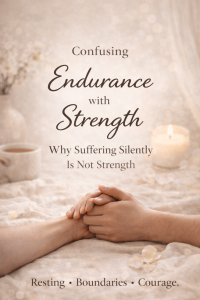
Why Suffering Silently Is Not Strength
Many people grow up believing that strength looks like endurance. Staying quiet. Carrying pain alone. Smiling through discomfort. Holding everything together without complaint. Over time, this belief becomes deeply ingrained, shaping how love is given, how boundaries are set, and how suffering is handled. Endurance is praised, while expression is dismissed. Silence is rewarded, while honesty feels dangerous.
Confusing endurance with strength often begins as a survival strategy. When your needs were overlooked, misunderstood, or minimised, you learned to adapt by asking for less. You learned that being “easy,” “strong,” or “low maintenance” kept the peace. Your ability to endure became your value. But what once protected you can quietly imprison you if left unexamined.
Suffering silently may look composed on the outside, but internally it creates emotional isolation. Pain that has nowhere to go does not disappear. It settles into the body, the nervous system, and the heart. It shows up as exhaustion, resentment, emotional numbness, or a quiet sense of being unseen even in close relationships. Silence may avoid conflict, but it also prevents connection.
True strength is not the absence of need. It is the courage to acknowledge it. Strength is not how much you can tolerate, but how honestly you can respond to what hurts. When endurance becomes the goal, your own well-being becomes secondary. You start measuring love by how much discomfort you can survive rather than how safe you feel.
Suffering silently often disguises itself as maturity, loyalty, or faithfulness. You may tell yourself that patience is noble, that endurance is virtuous, that speaking up would be selfish or dramatic. Yet strength that requires self-erasure is not strength that leads to wholeness. It leads to depletion. It teaches you to disappear in relationships while calling it resilience.
There is a quiet cost to always being the one who endures. Over time, you may stop trusting that your needs matter. You may hesitate to express emotions because you fear being a burden. You may pride yourself on how much you can handle while secretly longing to be held, understood, and supported. This inner contradiction is exhausting.
Strength is not proven by silence. It is revealed through truth. It takes courage to say, “This hurts.” It takes strength to admit when something is no longer sustainable. It takes bravery to choose honesty over comfort, clarity over avoidance, and self-respect over approval. Speaking your truth does not make you weak. It makes you whole.
Healing begins when you redefine strength. Strength is learning when to rest. Strength is asking for help without shame. Strength is setting boundaries even when it feels uncomfortable. Strength is recognising that love should not require constant endurance to survive.
You were not created to suffer quietly to be worthy of love. You were created to be seen, heard, and supported. Letting go of silent suffering does not mean you are failing. It means you are finally honouring yourself.
Strength is not how much pain you can carry alone. Strength is knowing you no longer have to.